
LeukoVision: AI-Powered Early Detection System for Leukemia Cells
Product-Based Capstone developed for Bangkit Academy (Google, GoTo, Traveloka) to detect and classify leukemia cells from microscopic blood images using CNN deep learning.
Technologies & Analytical Stack
Problem Context & Solution Architecture
1. Title and Problem Background LeukoVision is a product-based capstone project developed as part of the Bangkit Academy graduation requirements (supported by Google, GoTo, and Traveloka, Batch 2 2024). Driven by the high prevalence of leukemia and the clinical challenges of manual, time-consuming diagnostic procedures, LeukoVision was built as an integrated, intelligent application designed to assist medical personnel in detecting and classifying leukemia cells from microscopic blood images quickly, accurately, and efficiently.
2. Dataset & Tools Used - Dataset: Public blood cell image dataset from Kaggle for Acute Lymphoblastic Leukemia (ALL) classification. - Tech Stack & Tools (Machine Learning): Python, TensorFlow, Keras, scikit-learn, Pandas, NumPy, Matplotlib, Jupyter Notebook, Google Colab. - Ecosystem Integration: Collaborated with Cloud Computing (Node.js, Express.js, Google Cloud Platform) and Mobile Development (Kotlin, Android Studio) teams, using Git & GitHub for version control.
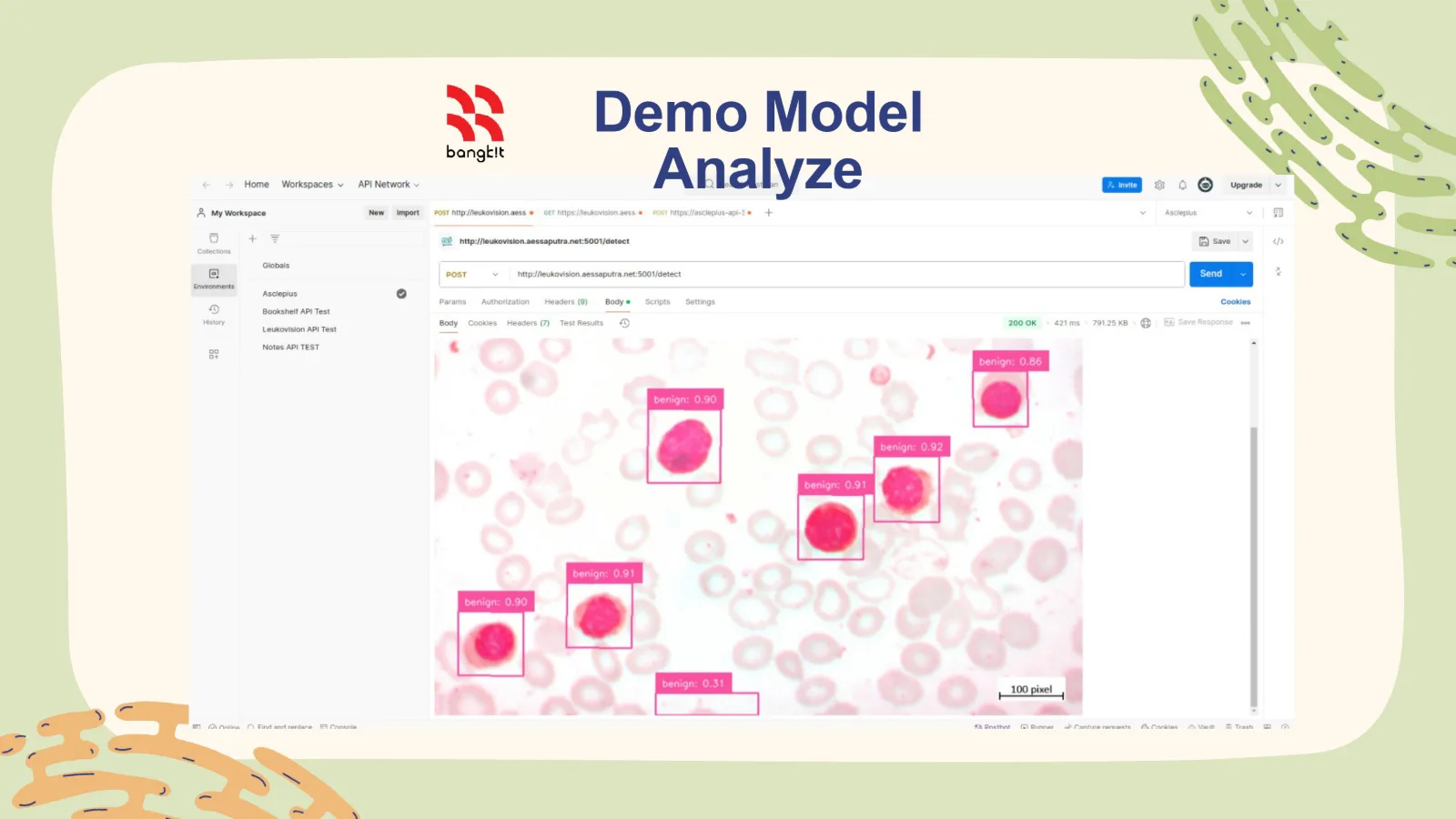
3. Analysis & Development Workflow - Data Preprocessing & Exploration: Microscopic image resizing, pixel normalization, and train-validation-test data splitting. - Model Architecture & Training: Designed and trained a Convolutional Neural Network (CNN) classification model using TensorFlow and Keras to accurately recognize visual patterns of abnormal blood cells. - Model Optimization & Evaluation: Evaluated model performance using accuracy and loss metrics, optimizing architecture for cloud production. - API & System Integration: Connected model to backend server (model-api) hosted on GCP for real-time mobile inference.
4. Insights and Solution Impact - High Accuracy & Diagnostic Speed: Drastically cuts down initial identification time compared to manual methods. - Cross-Functional Collaboration: Bridged ML research, cloud infrastructure, and mobile interfaces. - Clinical Application Potential: Provided a portable, accessible decision-support tool for healthcare professionals.